Design work for the DISKLESS systems started late 1989. The basic
motivation for the project was the desire for more workstations
for CP/M users. However, we didn't want to further extend the
ORDINATOR system and opted for single-user machines instead, hardware prices
being much lower then before.
We envisioned to build several DISKLESS machines. To make this possible,
we had a much more extensive design phase then ever before, attempting
to use our accumulated knowledge to create an extensively documented
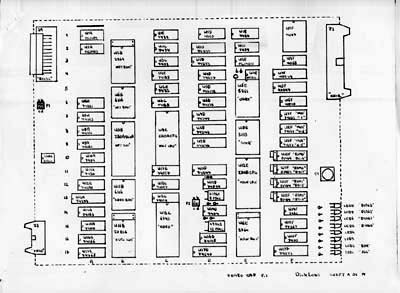
first-time-right design. The system would fit on a single large circuit
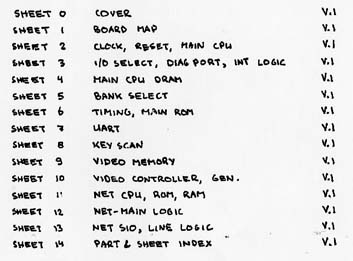
board; the finished schematics set consists of 15 sheets including
cover, board map and part/sheet index.
schematics title (sheet 0)
sheet index (sheet 14)
Having built or modified four computers with disk drives and given the
availability of hard disks over the LAN network, we felt that the DISKLESS
computers wouldn't need disk drives, hence their name. They would have
an on-board integrated LAN processor instead, effectively making
them dual-processor boards.
board map (sheet 1)
The DISKLESS design was based on a 6 MHz Z80B main processor with
128 KB of general-purpose DRAM (4 x 81464) and 8 KB of EPROM (2764).
It included an on-board memory-mapped video display featuring 2 KB
of display SRAM (6116) and 32 KB of character EPROM (27256), which
supported 4 separate character sets. The system also contained a
UART (8251), a timer (8253) for operating system support and a
custom keyboard interface. A simple
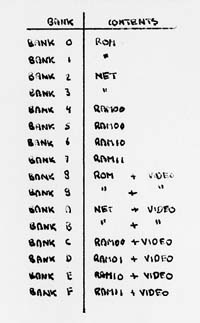
bank-switching system with two banks allowed the processor to access
all of the system's memory, including the 2 KB SRAM (6116) of the
4 MHz Z80A LAN processor, which also had its own 8 KB of EPROM (2764).
bank numbering (sheet 5)
Unfortunately, only a single DISKLESS system was ever built.
We also had some problems finding a keyboard for it,
because we needed a type of which several where available.
Software for the DISKLESS never got beyond the monitor program stage,
using the new UM (Universal Monitor) package.
We had intended to run CHAOS, a network operating system,
on the machine and then gradually convert all our other systems
to run CHAOS as well, but this never transpired.